Top Signs You Need Garage Door Service – Don’t Ignore These
Not every garage door symptom is equal. A squeaky roller is a 30-day maintenance item. A door that hesitates at the same spot on every cycle is often a cable tension problem that’s one cold morning away from a full jam. Knowing which category your symptom falls into is the difference between a $75 lube job and a $500 emergency call. This post gives you a simple triage system so you can figure out what you’re dealing with. And if you’d rather not sort it out yourself, call (866) 834-6826 and we’ll take a look.
Start Here: The Three-Tier Urgency System
Before we get into individual symptoms, here’s the framework that holds this whole article together. Every sound, wobble, and hesitation you notice on a garage door belongs in one of three buckets, and the bucket tells you what to do next. In Chesapeake, we’ve run through this same triage with enough homeowners to know it works.
Tier 1 – Service within 30 days (maintenance): The door works reliably but something has drifted out of spec. Lubrication has dried up, a roller has worn flat, the weather seal has hardened, or the opener chain has loosened. None of these will strand you tomorrow, but left alone they accelerate wear on springs, cables, and the opener motor.
Tier 2 – Service this week (repair): The door still opens and closes, but it’s telling you a component is failing. Uneven movement, a grinding noise, an opener that strains, a door that reverses for no obvious reason. You can use the door, carefully, but schedule repair before it becomes a Tier 3 problem.
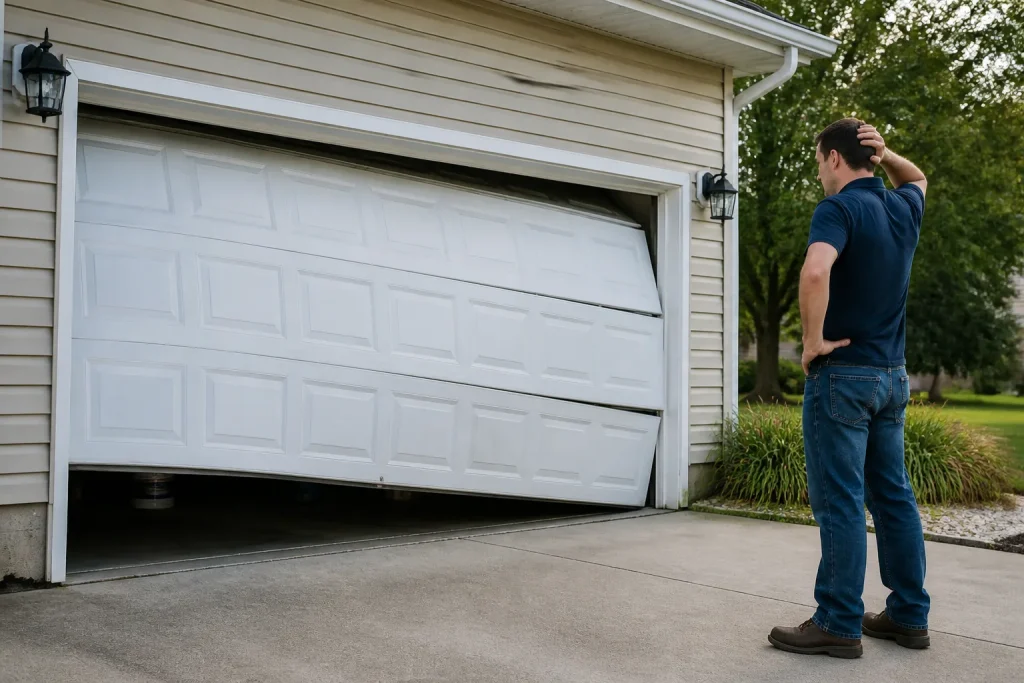
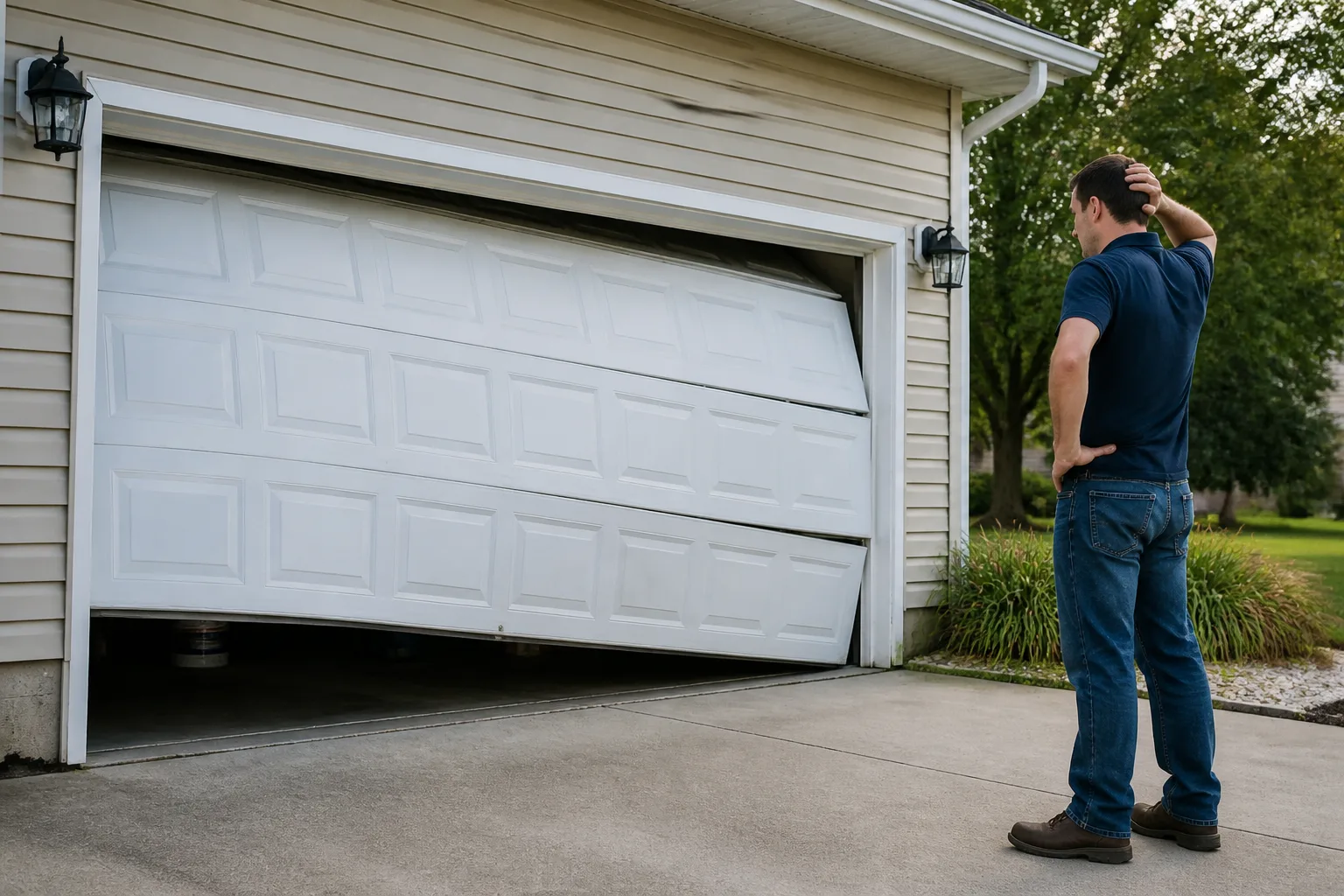
Tier 3 – Stop using the door now (safety): Something has already broken or is about to fail in a way that can drop the door. A snapped spring, a door hanging crooked, a cable that’s jumped its drum, or a door that won’t stay up when you let go. Do not operate it. Call for emergency service.
The rest of this article assigns specific symptoms to each tier, so you can match what you’re noticing to what you should do.
Signs That Mean Stop Using the Door Today
A garage door that has failed a safety component should not be cycled again, even once. The reason comes down to how the door is engineered. Torsion springs, extension springs, and the cables they connect to carry the full weight of the door, which can run several hundred pounds. When a spring snaps or a cable lets go, the door is suddenly unsupported, and the opener motor is not designed to hold that load. A door in this condition can come down hard, on a car, on a person, or on the frame.
Put the door in the stop-now tier if you notice any of the following:
- A loud bang from above the door followed by the door becoming very heavy or refusing to open. That’s the signature of a broken torsion spring.
- The door hangs visibly crooked with one side higher than the other and won’t close flush.
- A snapped cable – usually a loose wire whipping off the drum, or a cable lying slack along the side of the door.
- The door drops partway after you let go of the handle. A balanced door holds its position roughly halfway up. A door that slides down is unbalanced and unsafe.
- Rollers out of the track, or the track visibly bent. Forcing the door here will bend the panels and can drop the door.
Springs and cables are the two components where we always recommend a trained technician. This is not a job for a homeowner with a ladder and a YouTube tab. High-tension spring work requires proper winding bars and the right technique, and a mistake can cause serious injury. The good news is this is exactly the kind of repair our technicians handle every day for brands like Clopay and Wayne Dalton doors.
Signs That Mean Schedule Service This Week
This is the widest category, and it’s where most homeowners wait too long. A Tier 2 symptom means a component is failing but hasn’t failed yet. You can keep living with the door, using it as little as possible, while you line up a repair.
The asymmetry test. This is the single most useful check you can do on your own. Stand inside the garage and watch the door as it opens and closes. If it moves evenly side to side, your springs and cables are likely balanced. If one side lags behind, the gap between the door and the frame widens as it travels, or the door rises at a slight angle, the problem is almost always a cable tension issue or a spring that’s lost tension on one side. Not a track issue. That distinction matters because the repair approach is completely different. Straightening a track is quick. Diagnosing and adjusting spring or cable balance is a different job entirely, and doing it wrong makes the imbalance worse.
Other Tier 2 signs to act on this week:
- Grinding or scraping as the door moves. Usually a dry or worn roller, sometimes a slightly misaligned track.
- The opener strains audibly on the way up, or pauses mid-travel. That’s usually mechanical resistance, not a failing opener board (more on that below).
- The door reverses unexpectedly for no obvious reason. Often a safety sensor issue, sometimes resistance the opener reads as an obstruction.
- Rust streaks at the spring anchor points. Cosmetic on the surface, but it can signal moisture getting into the spring hardware where it matters.
Opener Behavior Is a Diagnostic Clue, Not a Verdict
When a homeowner in Chesapeake calls about an opener, the instinct is often to assume the motor is dying. Much of the time, the opener is fine. It’s doing exactly what it’s designed to do: sensing resistance and stopping or reversing, because the door itself has become hard to move. A Genie or Chamberlain opener with a healthy motor will struggle if the springs are weak, the rollers are stiff, or the tracks are binding.
Here’s how the behavior points you toward the right answer:
- Door reverses on the way down, repeatedly, at roughly the same spot. Check the safety sensors first – something blocking them, or a spider web across the lens. If the sensors are clear and it still reverses, look for an obstruction the door is hitting on the way down.
- Door reverses on the way up. Usually mechanical resistance. The opener feels the door binding and backs off.
- Opener runs but the door doesn’t move. Often a stripped gear, a broken belt, or the manual release has been pulled. Worth a technician’s eye to diagnose clearly.
- Opener motor hums but the door strains. Classic sign the door is heavy – worn springs or stiff rollers. The opener is trying hard and losing.
Brand familiarity matters here. Each opener brand has quirks in how they report faults and how their internal logic trips a reversal. An Amarr door paired with a LiftMaster opener behaves differently from a Wayne Dalton with a Genie. Diagnosing by brand habits saves time, and it avoids the most expensive mistake in this category: replacing an opener that was never the problem. Our technicians have up to 13 years of experience and we work on the eight major brands, so you get a straightforward diagnosis instead of parts-swapping guesswork.
If the opener itself turns out to be the failing component, we handle garage door opener repair as a core service.
Why January and February Make Symptoms Worse in Chesapeake
We see more garage door service calls in Chesapeake during January and February than any other part of the year, and the reason is physics. Cold weather tightens metal and thickens lubricant. Springs, cables, and tracks all shrink very slightly, which is enough to push a component that was borderline in October straight into failure in January. Lubricant that was fine at 70 degrees turns gummy at 30, and rollers start dragging where they used to glide.
The behavior you notice in winter is unusually telling. If a door is noticeably noisier or slower in cold weather than in summer, that’s not just the season. It’s telling you which component was marginal. A spring that was slightly weak all year shows its weakness dramatically in the cold. Rollers that were near the end of their life start squealing. Cables that had a bit of slack start slapping. We use that pattern as a diagnostic input – how a door behaves in cold versus warm weather narrows down which component needs attention.
The practical takeaway: if your door gets noisier or heavier every winter, schedule service in spring or fall before the next cold snap tests it. Routine lubrication and roller checks before November are a small cost compared with a broken spring on a January morning.
Visual Signs Most Homeowners Walk Past Every Day
Some of the clearest warnings are visible from the driveway if you know where to look. None require any tools. Take five minutes on a sunny day and walk around the car.
- Gap patterns at the bottom seal. The weather strip should touch the floor evenly across the full width. A widening gap under one side means the door is out of balance. Uneven gaps around the sides mean the seal is worn or the door is off-square. Small gaps let in cold air, moisture, and pests, and they also tell you the door isn’t moving evenly.
- Rust streaks at spring anchor points. Look where the springs attach to the wall bracket above the door. Rust or discoloration there is a hint the hardware is getting moisture, and the anchor point is the highest-tension part of the system.
- Cable fraying. Look at the steel cables running along the sides of the door. They should be smooth and taut. Frayed strands, a bird’s-nest tangle at the drum, or a cable lying slack against the track are all signs of trouble.
- Broken or missing rollers. Rollers are the small wheels that guide the door through the track. Look for cracked wheels, missing rollers, or wheels that have clearly gone flat on one side.
- Bent or dented tracks. Tracks should be straight and smooth. A small dent can catch a roller and force the opener to work harder with every cycle.
Every one of these is a routine maintenance or repair item when caught early. Left alone, they compound into spring, cable, or opener failures.
When to Call a Pro
You can lubricate rollers, tighten the weather seal, clear the safety sensors, and check that the manual release is engaged. Beyond that, the work carries real risk. Springs and cables are safety-critical, and working around high-tension parts with the wrong tools is how serious injuries happen. If your symptom is in Tier 3, don’t open the door again, and call right away. If it’s Tier 2, schedule a repair this week. If it’s Tier 1, book a routine tune-up and skip the guesswork. Our team handles garage door repair across every tier, and if the door itself is past its useful life, we also do garage door installation.
Related services in Chesapeake: Repair, opener service, spring replacement, new door installation, and emergency service – all from a single-trade specialist that only works on garage doors. Full details at Chesapeake Garage Door Repair Pros.
The Bottom Line
The single most useful takeaway is the tier system. A door that hesitates, reverses, or moves unevenly is telling you about mechanical resistance or balance long before it fails. A door that has snapped, dropped, or hung crooked is telling you it’s already failed. Match the symptom to the tier, and you’ll know whether to lube, schedule, or stop. If you’re in Chesapeake and need help, Chesapeake Garage Door Repair Pros offers free estimates – call (866) 834-6826. Emergency service is available for situations that can’t wait, and every repair starts with a written quote so you know the price before any work begins.
Frequently Asked Questions
The earliest reliable signs are uneven movement side to side, a scraping or grinding sound, and the opener straining on the way up. These usually mean a roller, cable, or spring is failing before the door has stopped working. If any of these appear, schedule service this week – catching it early keeps the repair small.
Stop using the door if you hear a loud bang from above the door, see a snapped or slack cable, notice the door hanging crooked, or find the door won’t stay up when you let go partway. These mean a spring or cable has failed and the door is unsupported. Don’t cycle it again. Call (866) 834-6826 and we’ll dispatch emergency service.
Yes. Each brand has its own quirks in how it behaves when a component starts to go. A Genie opener reports faults differently than a Chamberlain, and a Clopay door with a Wayne Dalton opener behaves differently than an Amarr with a LiftMaster. We work on all eight major brands, so the diagnosis is brand-aware rather than a general check.
No, we don’t recommend it. Torsion springs are under high tension and require proper winding bars and technique. A mistake can cause serious injury. Spring replacement is a trained-professional job, and it’s one of the core services we handle. Call (866) 834-6826 for a free estimate.
Written by the team at Chesapeake Garage Door Repair Pros.
Need Garage Door Help?
Call Chesapeake Garage Door Repair Pros - the local pro we connect you with is licensed and insured, here with fast after-hours help in Chesapeake.
(866) 834-6826